-
 1102 N Delaware Ave, Philadelphia, PA 19125
 -
 (215) 770 3007
- 9:00 AM – 9:00 PM
1102 N Delaware Ave, Philadelphia, PA 19125
(215) 770 3007
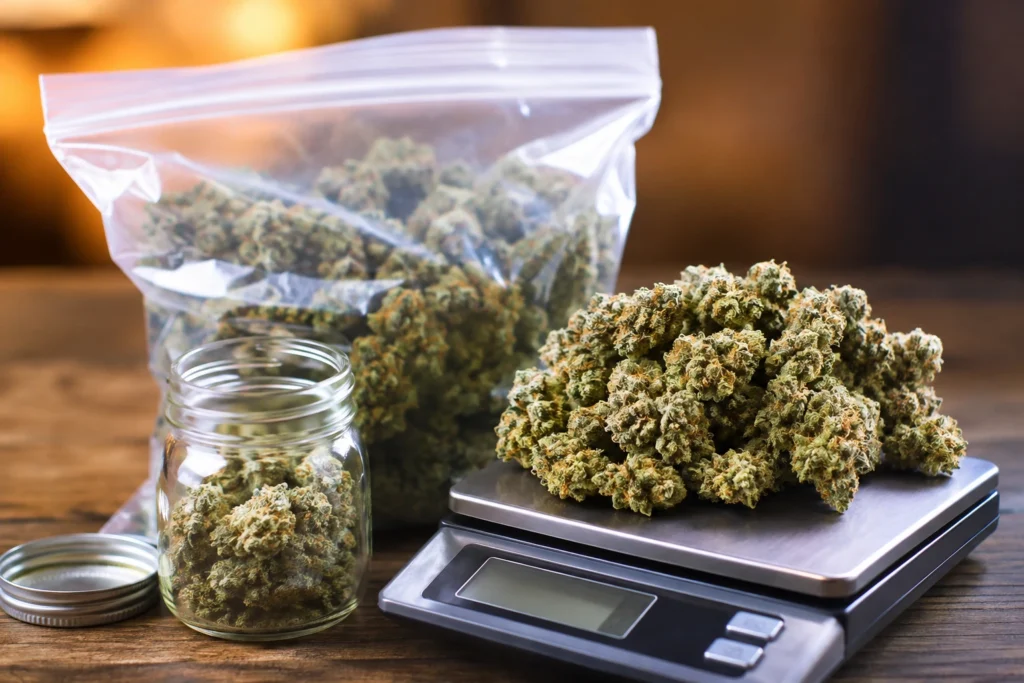
When looking for information on how much is a quarter pound of weed, it can be safely stated that a quarter pound is equal to 4 ounces, or 113.4 grams.
While it may seem simple, weighing cannabis is complicated by the fact that “quarter” is commonly used to refer to a quarter-ounce quantity, which equals 7 grams. Therefore, a quarter pound is much bigger than that.
This guide defines what exactly a quarter pound of weed is, explains its relationship with other quantities of cannabis, provides reasons why you may have seen mentions of both 112 grams and 113.4 grams, discusses the factors that influence its price, and gives the information you should know about the legal possession limits.
A quarter pound refers to one-fourth of a pound.
The basic equation is:
1/4 pound is approximately 113.4 grams. As per the National Institute of Standards and Technology (NIST):
Therefore, answering the question of how much is a quarter pound of weed will give the following answer:
One may also see mentions of 112 grams in discussions about cannabis. This is due to using 28 grams for an ounce in order to make calculations easier: 28 x 4 = 112. The exact conversion is 113.4 grams.
This is probably the easiest cannabis measurement mistake to make.
A quarter ounce and a quarter pound are completely different amounts.
| Measurement | Weight |
|---|---|
| 1 gram | 1 gram |
| Eighth | 3.5 grams |
| Quarter ounce | 7 grams |
| Half ounce | 14 grams |
| Ounce | 28.35 grams |
| Quarter pound | 113.4 grams |
| Half pound | 226.8 grams |
| Full pound | 453.6 grams |
A quarter ounce is 7 grams. A quarter pound is 4 ounces.
That means a QP contains roughly 16 times as much cannabis as a quarter ounce.
So if you see “quarter” on a cannabis menu, check the unit before assuming what it means.
QP is simply shorthand for quarter pound.
You may see the abbreviation in cannabis conversations, menus, cultivation discussions, or other places where larger quantities are being discussed.
Other terms can refer to the same amount, including:
The abbreviation doesn’t describe potency, strain, quality, or THC content. It only describes the weight.
There isn’t a reliable nationwide price for a quarter pound of cannabis.
The final cost can vary significantly based on:
This is one reason older articles that give a single “average QP price” can become misleading. Cannabis markets change, and a price that was common in one state or even one city may have little relevance somewhere else.
Instead of focusing only on the total price, look at the price per gram.
For example, imagine a hypothetical legal purchase of 28 grams for $280. That’s:
$280 ÷ 28 = $10 per gram
If another product costs $900 for 113.4 grams:
$900 ÷ 113.4 ≈ $7.94 per gram
The second example has a lower mathematical price per gram, but that doesn’t automatically make it a better purchase. Product quality, freshness, taxes, legal limits, and your actual needs still matter.
Actual dispensary prices should be checked locally rather than relying on a national estimate.
Two batches can weigh exactly the same and still look very different.
Cannabis flower varies in density and structure. Compact buds may take up less physical space than loose, airy flower even when both weigh the same.
Other factors can affect appearance too, including:
For that reason, you cannot accurately determine a QP by looking at it.
Weight is measured by mass, not by how full a container appears.
An eighth weighs 3.5 grams, whereas a quarter-pound measures about 113.4 grams.
Using the precise conversion,
113.4 ÷ 3.5 = 32.4
Since cannabis selling weight calculations usually are not precise, a QP is said to be 32 eighths.
This minor variation results from the usual practice of rounding an ounce to 28 grams when it actually equals 28.3495 grams.
This implies that a QP is a huge amount compared to other smaller amounts used for retail purposes.
An ounce contains approximately 28.35 grams.
A quarter pound contains 4 ounces.
So:
1 QP = 4 ounces
This makes a QP four times the weight of an ounce.
For someone trying to understand cannabis measurements, this is probably the easiest relationship to remember:
Ounce → 1
Quarter pound → 4 ounces
You don’t need to memorize every conversion if you remember that one.
There isn’t a standard answer because cannabis consumption differs from person to person.
Someone who uses cannabis occasionally may have the same quantity for much longer than someone who consumes it frequently.
The amount used at a time also changes the calculation. For example, purely as a mathematical exercise:
These numbers are not recommendations for how much cannabis someone should consume. They’re simply ways to understand the size of the quantity.
The effects of cannabis can vary according to factors including THC concentration, frequency of use, method of consumption, previous experience, biology, and whether other substances are involved.
NO!
Potency is not the same as weight.
A quarter pound indicates that you have a certain quantity of cannabis in terms of weight. It does not indicate the percentage of THC contained in that cannabis.
For instance, two items may weigh 113.4 grams but have varying percentages of cannabinoids.
When buying regulated cannabis, you should look at the package to get the details on THC, CBD, and other cannabinoids where available.
It is important to note that THC percentage does not indicate the effect on the individual in question since there are various factors.
This is where the answer becomes state-specific.
A quarter pound is approximately 4 ounces, but legal cannabis possession limits are not the same everywhere.
Depending on the jurisdiction, the law may establish separate limits for:
For instance, as of now, the Medical Marijuana Authority in Oklahoma specifies that the maximum amount of medical marijuana a licensee may have with them personally is 3 ounces (84.9 grams), while at home, it is 8 ounces (226.4 grams), all within the limits of the state.
A QP is around 113.4 grams, so the answer will be different based on the location and the scenario.
Another reason the Oklahoma case is relevant here is that the simplistic response of “a quarter pound is legal” or “a quarter pound is illegal” is not comprehensive enough.
If the amount in question is significant, see the current state cannabis regulator regarding this particular situation.
A state may allow cannabis possession but still place restrictions on how much can be purchased in one transaction or during a particular period.
Medical cannabis programs can also have rules that differ from adult-use programs.
So three separate questions should be considered:
These limits can change, so current government information is the best source when legality matters.
Not necessarily.
Buying a larger quantity can sometimes reduce the price per gram, but that doesn’t automatically make it the best choice.
A few things can change the equation.
Cannabis flower can lose quality over time, especially when it is exposed to unsuitable environmental conditions.
A larger amount requires more attention to storage. Excessive heat, light, air exposure, or inappropriate moisture conditions can affect the product.
Buying a large amount of one strain may not make sense if you haven’t tried it before.
A discounted product isn’t useful if purchasing or possessing that amount isn’t permitted under the laws where you live.
For many consumers, the “best value” isn’t simply the lowest price per gram. It’s the combination of price, quality, freshness, legality, and how much they realistically expect to use.
If cannabis is legally possessed, keeping it in a suitable environment can help preserve its quality.
General storage practices include:
There is no need to rely on appearance alone to judge whether stored cannabis remains suitable. Changes in smell, texture, or visible contamination can be signs that the product should not be used.
The CDC specifically recommends keeping cannabis products in a locked, childproof container and away from children’s sight and reach.
The weight of the cannabis will not define the effects it has on health alone.
There are other factors like the percentage of THC in the cannabis, how often it is used, the way it is taken, and personal factors that may determine the effects and risks involved.
The substance may have an effect on the user’s attention span, memory capacity, coordination ability, judgment ability, and reaction time. The CDC also states that cannabis may affect one’s ability to drive and this includes reaction time and coordination.
This implies that having a lot of the substance does not mean they need to take more of it.
A quarter pound is approximately 113.4 grams using the standard U.S. weight conversion.
There are 4 ounces in a quarter pound.
No. A quarter ounce is 7 grams, while a quarter pound is 4 ounces, or approximately 113.4 grams.
QP is short for quarter pound. It refers to 4 ounces of cannabis, approximately 113.4 grams.
Cannabis measurements are often rounded for convenience. If an ounce is treated as 28 grams, four ounces becomes 112 grams. The exact standard conversion is approximately 113.4 grams.
There is no dependable nationwide price. Cost depends on location, product quality, taxes, market conditions, and whether the cannabis is sold through a medical or adult-use program.
Yes. Compared with common retail quantities such as an eighth, quarter ounce, half ounce, or ounce, 113.4 grams is a substantial amount of cannabis.
It depends on the laws where you live. Medical and adult-use programs may have different limits, and purchase limits can differ from possession limits.
No. Cannabis density, bud structure, moisture, trimming, and packaging can make the same weight occupy different amounts of space.
No. A QP describes quantity, not quality. The weight doesn’t tell you anything by itself about potency, freshness, cultivation quality, or cannabinoid profile.
Now, what is the value of a quarter pound of weed? A quarter pound of weed equals 4 ounces, which is equal to about 113.4 grams.
The major difficulty in calculating the quantity of a quarter comes from the term “quarter.” One quarter ounce is equal to 7 grams, whereas one quarter pound is four ounces, a considerable amount.
The pricing is much harder to determine due to varying cannabis market conditions, products and different laws and limitations in each state or country. There may also be restrictions that limit a quantity of a drug in your area, making a QP not necessarily a legal purchase or possession of marijuana.
Thus, to calculate the amount of marijuana, use the basic formula, and find out the relevant limitations and laws of your region.
